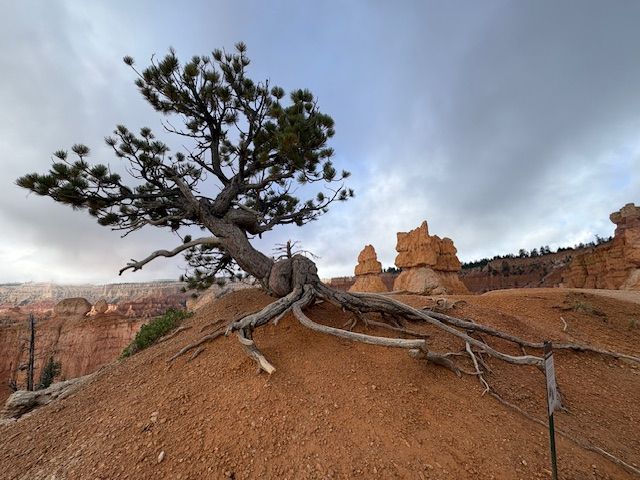
A few weeks ago I had the privilege of going on a hiking trip to the Southwest. One of the parks we visited was Bryce Canyon National Park . The sky looked moody as we started down the trail, and I was reminded that hikers had been rescued off this trail when a flash flood tore through the canyon just the week before. The floor of the canyon still showed debris from the ferocity of the water. I loved looking at all the columns of hoodoos and the striking orange rock formations, but this lone tree caught my attention, and I thought about it all week. It didn't stand tall and majestic. It looked more scrubby and worn. Its roots were exposed from years of erosion as they attempted the almost impossible task of finding water and nutrients in a thin layer of dirt over hard rock. It twisted and turned as it leaned into the harsh elements nature threw its way. And yet it stood, almost defiant against its environment. I think that tree represents how many of us feel at times. Maybe most of the time! Tired. Worn out. Battered. Barely hanging on. Stifled by our environment. Starving for nourishment — emotionally, physically, relationally, or spiritually. Utterly depleted. But the tenacity of that tree is what struck me the most. And I wondered: what gave it that tenacity? And what can I learn from it? I noticed it didn't try to be the tallest, most beautiful tree in the park. But it definitely developed its potential. It persevered against the harsh elements. There was life in that tree even if its growth seemed stunted! Our tendency is to compare our lives with someone else's — a friend we envy, maybe, or a stranger on social media. But our environment isn't identical to theirs. Often it's drastically different. And yet we compare and expect the same outcome. We berate ourselves for not living up to their potential. I smile sometimes at how silly we are. That tree would have been judged a failure next to the trees in the national forests we passed through on our trip, but it was a beautiful, resilient tree overcoming incredible odds right where it was growing. My friends, please join me in the hard work of resisting comparison and focusing instead on the potential God is developing within each of us. I was also amazed by the tree's root system. It didn't try to burrow straight down. It spread out, and it's still spreading despite the erosion. That tree doesn't depend solely on its trunk, branches, or even leaves to support it. Sure, all of those play a role, but its root system is what gives it the most support and keeps it anchored on top of the rock. Who is your root system? For me, it's God, my family and close friends, my church community, and my clients, who bring so much purpose to what I do. I've learned that when things are hard, I need a root system bigger than myself. I've humbled myself and leaned into the support of others when the elements of life felt too harsh to withstand on my own. If you find yourself floundering, please reach out and ask for help. Yes, there will always be excuses not to ask, but God intended the family of God to be each other's root system. Don't stay isolated in your struggles. Lastly, I noticed that the tree leaned into the elements. It developed resilience by embracing its environment instead of trying to avoid it. This is hard to do! When I feel overwhelmed or anxious, I often want to hide or numb out to escape the feelings. You too? But I've learned that resilience is built by addressing the hard things while still honoring the limits of my body. This might look like: Prioritizing sleep during a stressful period. Addressing my emotions when something hard happens. Saying no when my schedule is too full to show up well for each commitment. Asking for help when I need it. Evaluating how my health may be interfering. This tree didn't become a symbol of resilience overnight. It took time and many adjustments for it to develop its strength and capacity. The same is true for you and me. So often we want healing to happen and resilience to develop in a moment. But it takes time. If you find yourself longing for the resilience of this Bryce Canyon tree, begin today with one step. Decide if you need to seek extra support, cut the contributors to comparison, or prioritize your health. Just one small step begins the path to resilience!
Do you ever feel like life is moving faster than you can keep up with? I do. So I went digging into the history of how news actually traveled, and it turns out I wasn't imagining things. Life really has sped up. Let me walk you through it, because it explains more about your body than you'd think. In 1776, news moved at the speed of a horse or a ship, and sometimes slower than the war it was reporting on. The Treaty of Ghent was signed in December 1814, but it took six weeks to cross the Atlantic. Andrew Jackson fought the Battle of New Orleans two weeks after the war it belonged to had already ended. The telegraph closed that gap. The Associated Press started in 1846, when five New York papers pooled money for a courier-and-telegraph relay to beat each other on Mexican-American War news. By the 1870s, the AP wire was the backbone of newspapers coast to coast. When the first working transatlantic cable went in in 1866, European news reached city readers by the next morning. Rural readers, stuck waiting on the mail train, stayed weeks behind. Radio and television took over in the 20th century, still riding on the AP wire underneath. Overseas footage could reach American living rooms the same day. Cable news pushed that down to real time — by September 11, 2001, people watched history happen live instead of waiting for the evening broadcast. Today the lag is seconds, and the source is usually a stranger's phone, not a newsroom. Wire services and reporters still do the actual digging, but social platforms and algorithmic feeds decide what you see first, and they usually beat professional verification to the punch. Speed isn't the problem anymore. Knowing what's true before you share it is. Here's what that means closer to home. A woman in 1776 spent her day on what was in front of her: feeding her family, supporting the war effort locally, running her house. Her stress was real, but she wasn't carrying Africa's wars or Asia's famines on top of it, because by the time that news arrived, it was already over. Even through World War II, women served their cause by investing in their own community. Worldwide events they couldn't touch were, for the most part, not part of their daily awareness. And when they were, it came through black-and-white photos and print — sterile, one step removed. Even the six o’clock news felt at a distance most nights. Social media changed that. Now a plea to save trafficked children and a plea to save dying coral reefs show up back to back in the same scroll. We watch villages in Africa pillaged by rebels, children starving as civil wars tear countries apart, cities flattened by earthquakes and wildfires — all shot on the phones of people living through it in real time. Every influencer has a cause, and plenty of them want you to feel something urgent enough to act, whether that's guilt, outrage, or a call to fix something four thousand miles away. I'm not minimizing what any generation before us dealt with. I'm giving you context for what makes ours different. When women in earlier generations felt worried, they could point that adrenaline at something in front of them and actually do something about it. Now, every time we watch a crisis unfold somewhere we have no power to change, our body still releases the same stress hormones it always has — as if we were about to step into that crisis ourselves. Except we can't. Your body doesn't know the difference between a threat in your kitchen and a threat on your screen. It reacts the same way either time. And it's not just the news — it's the constant hum of social media running in the background of your day, quietly keeping your body braced for something it will never actually need to respond to. That's a real cost. It pulls from the same reserves your body needs for the stress you can't avoid. If you're anxious most of the time, short-tempered in a way you don't like, sleeping poorly, or dealing with digestive issues that won't resolve, social media and the news cycle may be part of what's driving it. Try a sabbatical — no social media, no podcasts, no news, even for a few days. Let your brain settle. Let your attention come back to what's actually in front of you, and notice whether your body feels different. When you're ready to bring news back in, I'd point you to The Pour Over. It's non-partisan, comes with Scripture and prayer built in, and delivers everything in short pieces — enough to stay informed without getting pulled into the emotional undertow of events you have no way to change.

You've probably heard the line, "Nothing is certain except death and taxes." It's usually attributed to Benjamin Franklin, who wrote it to the French scientist Jean-Baptiste Le Roy — expressing his own anxiety about not hearing from Le Roy for over a year during the chaos of the French Revolution. Every era has its uncertainty. But is it just me, or does the world feel more uncertain lately? Maybe it's the upcoming midterm elections. Maybe it's the unrest in the Middle East. Maybe contagious viruses just feel more ominous since COVID. And then the news serves up one terrible headline after another that I wasn't even thinking about until I read it. Maybe current events barely register for you, but you still struggle to feel safe because of something that happened to you, or to someone you love. It's hard to feel certain about anything after what you've been through. If that's you, I am truly sorry, and I lament with you in that! Here's what's actually happening in your body: uncertainty triggers the same stress response as a real physical threat. You have a small gland in your brain called the amygdala, and it interprets ambiguity the same way it interprets danger. Your body responds accordingly — racing heart, shallow breathing, sweating, blood rushing to your limbs. At the same time, the amygdala suppresses your prefrontal cortex, which slows your thinking and makes it harder to make decisions or regulate your emotions. Live in that state long enough, and it becomes an allostatic load on your body: chronically elevated cortisol, a suppressed immune system, more inflammation, reduced digestive capacity, and hormones out of balance. You might also notice more anxiety, more fatigue, and everyday tasks feeling like more than you can carry. I wish we could avoid uncertainty. I think you do too. We are finite people held in the hands of an infinite God. Some days I catch myself thinking that if my life had no uncertainty, I'd be less stressed. Deep down, though, I know that's not true. No uncertainty would mean I'd know everything — including every scary thing headed my way — and that would stress me out more, not less. So if uncertainty isn't going anywhere, how do we keep it from wrecking our bodies? Limit your knowledge. I know that sounds backward. We have the whole internet in our pockets, and we can watch the news unfold in real time. But most of what we're consuming is about things we can't control or influence. That turns knowledge into a burden. Cut back on the things you have no say in, and focus on what's local and within your reach. Cut your social media scroll. Comparison breeds "what if" thinking and discontentment. And the algorithms are tracking every half-second pause in your scroll, then feeding you more of exactly what stirs up your uncertainty. Build a budget and stick to it. A budget lets you plan for what you need and prepare for the unexpected. It slows the kind of spending that feeds on uncertainty. Cut back on caffeine and other stimulants. They stack extra stress hormones on top of what your body is already producing, keeping you stuck in an activated, wound-up state. Write down reminders of God's faithfulness — put them where you'll see them. When Moses handed leadership over to Joshua, right before Joshua had to lead the Israelites into the Promised Land, Moses gave him this: "It is the Lord who goes before you. He will be with you; he will not leave you or forsake you. Do not fear or be dismayed." — Deuteronomy 31:8 (ESV) Joshua was afraid. Moses didn't hand him a plan — he reminded him who was going ahead of him. We can hold onto that same reminder. Ask if there's a deeper root to your uncertainty. Is there a past event, or a pattern, feeding what you feel now? That can be a loaded question, and it's often easier to sort through with a counselor or therapist who can help you connect what happened then to what you're carrying now. Uncertainty isn't going away. But we don't have to just absorb it. We can be strategic about how we handle it, and about lightening the stress load it puts on our bodies.
Address chronic stress & find calm with Eiro Wellness. Start your journey to wholeness today!
Eiro Wellness helps women overcome stress & trauma. Join our programs for guidance to calm & wholeness. Start your journey today!
Eiro Wellness offers guidance for women facing emotional struggles. Find healing and support through our programs today!

Understand how trauma affects the body & learn healing strategies. Start your journey to emotional well-being with Eiro Wellness.
Learn to manage anxiety with holistic strategies. Explore faith-integrated resources for women's wellness today!
Understand how your gut affects mental health. Get guidance on wellness & reclaim your energy with Eiro Wellness.
Explore essential health tests to manage stress & improve well-being. Start your journey to balance with Eiro Wellness today!